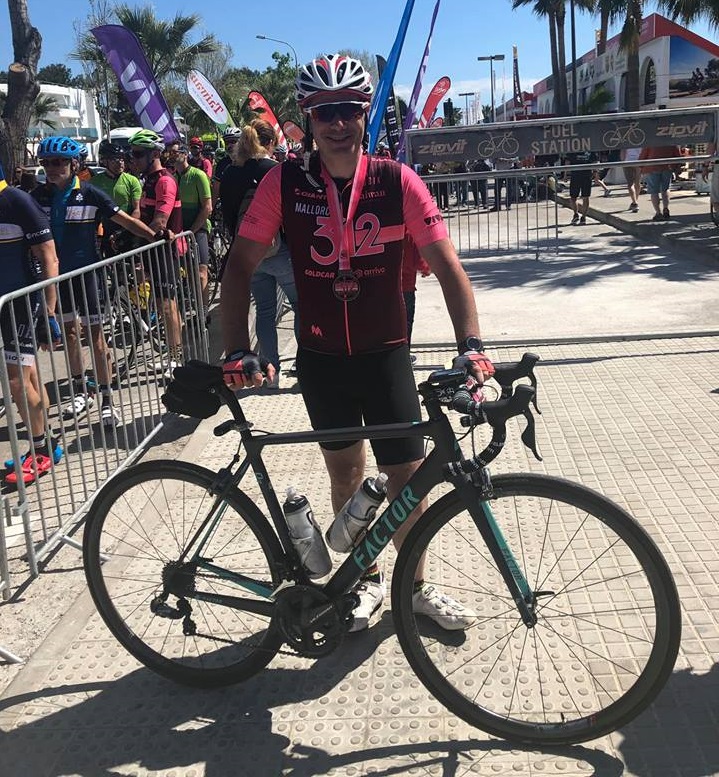
The picture above is My bike – along with yours truly – taken at the finish of the Mallorca 312 – the end of a 104 mile cycle. I hope that I look remarkably fresh, which leads onto the concept that a bike is not just a bike!
My bike is made by Factor – in Norfolk UK. In fact it’s a Factor O2. The bike is a high end road bike, and has been used by professional riders (it came second in the Tour de France a couple of years back).
But what makes the difference with bikes ? Why is this bike high end, and why should it matter ?
The difference in every aspect of the bike, from the frame, through to the wheels, the gears, the brakes, the saddle.
Lets examine each bit in turn.
The Frame
The frame of the bike is the most important part. The Factor is made of carbon so is very light. But carbon is not just carbon – different carbon weaves have different features and some are stiffer, lighter and significantly more expensive than others.
The carbon used on this frame is light, and very stiff where it needs to be stiff and less so where it doesn’t.
It’s important to have a frame that is stiff enough so that it doesn’t bend when you are cycling hard (believe me this happens and the result is that you waste your energy bending the bike rather than turning the pedals).
However, it needs to be soft in certain areas as well – you don’t want every minor bump to be sent through the frame into your ass!
The weight of the bike is important – at the end of the day, you have to pedal the weight around. The aim is to get the bike as light as possible – the frame on the Factor is only a few hundred grammes (I know this is hard to comprehend!) and the bike weighs in total under 8kg!
The geometry (the shape and tube lengths) make a big difference to the rider – it defines how easy it is to ride and whether the bike is more suitable for touring or racing. The Factor is built for racing, but unlike many race bikes has a bit more compliance so you don’t ride over a 50p piece and claim heads or tails!
The shape also has an effect on aerodynamics – air resistance has a massive effect to a cyclist!
The Wheelset
The wheels are very very important. After the actual rider these can have the most effect on drag.
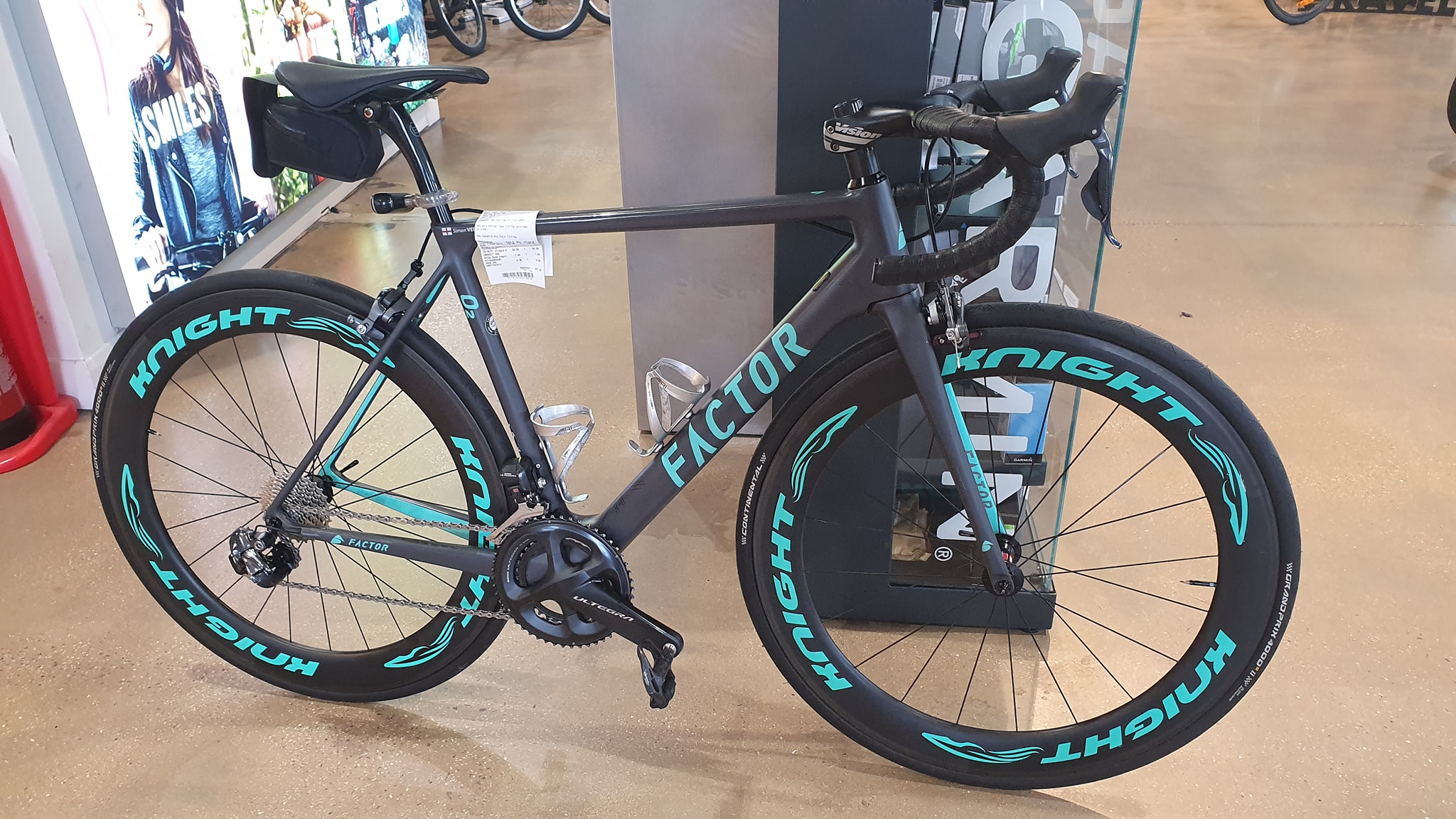
Generally wheels are made of aluminium or carbon. I have two sets of wheels.. A set of Black Inc 30s and a set of Knight Composite 65s… The picture from Mallorca has the Black Incs on – the pic above shows the Knights..
Apart from looking so much nicer (the Knights!) there are significant differences between the wheels.
The 30/65 refer to the depth of the carbon on the wheel rim. The deeper the rim, the more ability there is to shape the carbon to aid airflow and reduce air resistance.
In real terms, in normal use the Knights will be approximately 10% faster than the Black Incs on the same ride (for example my commute to work). Alternatively, you can maintain the same speed putting in less effort.
So why have two sets of wheels ? Why not just ride the big wheels all the time…. ?
The main reason is cross winds…. Once the wind comes from a direction of more than about 15 degrees from the side (as opposed to being from the front or behind) then the aerodynamics start to work against you. The Deep Rims start to act more like sails and the wind will push you across the road. It can become very tiring to keep the bike straight, and often dangerous to maintain speed and you need to slow down.
The second reason is weight. The bigger wheels have more material and are heavier – this adds a little to the weight of the bike, even more so when climbing!
Finally, the hubs are important. The Black Inc wheels have ultra-low resistance ceramic bearings. The effect of these can be easily seen when you go downhill and overtake everyone due to less friction slowing you down.
So, I’m riding the Black Incs.
Tyres
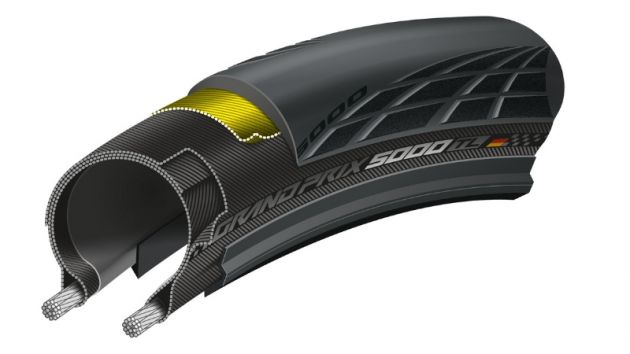
Tyres are another area with lots of options! They are not just bits of rubber!
There are two generic types of tyre – “Clinchers” which are the sort of tyres most will be used to with an inner tube inside, and “Tubeless” which – as the name suggests – don’t have inner tubes and are more like car tyres in this regard,
Why would one choose one over the other ?
Tubeless tyres have some key benefits – you can run them at lower air pressures (I use 80psi on tubeless compared to 100psi on clinchers). This makes them a bit softer to ride on and they tend to puncture less. However , if they do puncture they are a nightmare to get off the bike by the roadside – not a problem in the Tour de France when a mechanic with a spare wheel in only a minute away, but a major issue when you are 20 miles into the Peak District at 7am on a Sunday morning! Fortunately, there are mechanics available on the road on Ride Across Britain, so I’ve chosen tubeless for the ride.
Once the type of tyre has been picked, the tyre compound is the next most important thing. There are various types (just like for road tyres) – ranging from ultra light, ultra thin, very fast and grippy but easy to damage race tyres through to heavy armoured tyres that are slower on the road and often have less grip.
The final choice for me is a compromise but I’ve chosen some Continental GP5000 tubeless – which are fast yet not too fragile.
The width of the tyre is important too. The traditional theory is that narrow tyres were faster (less drag and the smaller contact area gives less rolling resistance), but they tend to be harder to ride on (you feel the bumps more). These days though, studies show that wider tyres can be faster overall – the slighter bigger contact patch with the road spreads the bike’s weight over a larger area so the pressure on the road overall is less.
I’ve gone with 28mm tyres – the widest that my bike will support.
Drivetrain
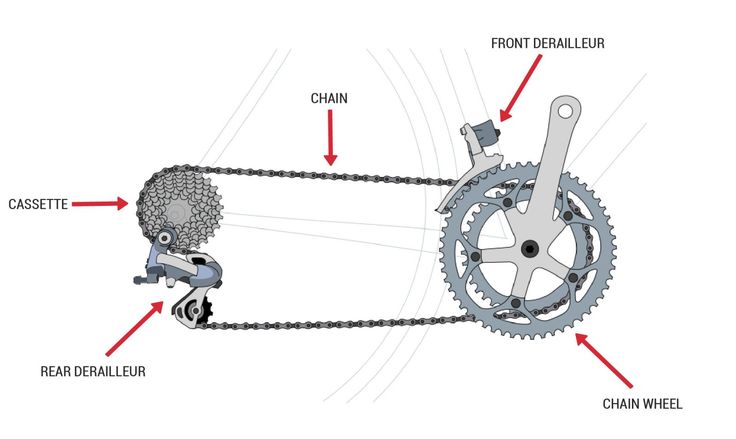
The Drivetrain consists of the elements in the picture above. Basically the front crank which attaches to the pedals and is driven by the cyclist through to the chain which is attached to the cassette on the rear wheel and runs through the read derailleur.
My bike runs a Shimano Ultegra DI2 drivetrain with a 50/34 Chainset and a 11-28 cassette….
What the hell does that mean?
The gears on a bike are similar to that on a car – low gears mean you can’t go fast but it’s easier to pedal. Higher gears mean that you can go faster but it’s much harder to pedal. Just like a car, you can get close-ratio setups (good for acceleration as you can switch between the gears).
The gear ratio is simply the ratio between the no of teeth on the front chainset and the cog on the rear cassette that is being driven.
The front chainset has two cogs – one with 50 teeth, the other with 34 teeth. This gives you two key adjustments to the overall driven ratio.
The rear cassette has 11 cogs! the smallest one has 11 teeth and the biggest 28 in my case. This means that the highest gear ratio is 50:11 which means that for every turn of the pedals the rear wheels turn 5x. The lowest is 34:28 which is almost a turn for a turn.
There are varying combinations available – and the potential choice for the rear cassette is a big discussion point between riders. Some will ride ratios up to 11-34 (ie the biggest cog has 34 teeth compared to the 28 I have and will reduce the lowest gear ratio to 1:1 and in theory make it easier to climb hills!)
However, my bike will only run up to a 28 largest cog on the cassette. Why is this ?
It’s down to the derailleur. This works by moving left and right to literally push the chain off one cog onto the one above or below it. As the chain moves up the cassette to the larger cogs, more chain is needed to go round the cog itself and the derailleur compensates by moving forward and backwards to release the tension on the chain. The shorter the derailleur is, the less if can move and this in turn restricts the size of the largest cog.
In reality, the benefit of the larger cog depends on the rider – riders who are used to the smaller cogs will generally be happy to cycle on the smaller 28 tooth cog anyway (this has bigger benefits of having more flexibility in the gearing you can pick as there is less gaps between the cog sizes on the cassette).
I’m happy to be riding on an 11-28 – I’m hoping that I don’t regret it though!
But what about the Di2 bit ?
My gear change is electric !
Manual gear changing is done using cables attached to the levers on the handlebars -gear changes are made by pushing one of two levers onto each lever system towards the middle of the handlebars to let in or out some cable which it turn pulls or releases the derailleur to change gear)
An electric system has a battery hidden in the bike tubes and small electric motors on the derailleurs (front and back). Gear changes are done by pressing buttons rather than pushing a lever
So what ?
Electric gear changes are easier – they can be done whilst you are pedalling (you need to stop pushing the pedals to change gear manually). You can also skip through gears very easily by holding the button down – rather than having to push a lever several times – this is really useful if you suddenly hit a steep hill unexpectedly where it’s much quicker to get from the highest to lowest gear (by several seconds which can stop you falling off!!).
Saddle, Handlebars and the other bits
Many cyclists will tell you that the Saddle, handlebars and pedals (see below) are the most important parts of the bike – they are, after all the only contact points the rider has with the bike.
Saddles are really important – get it wrong and it’s very uncomfortable and can cause friction sores (don’t even think about those) and cause you to shuffle around a lot losing power, slowing you down.
Logically you’d think that getting a more padded saddle is the requirement. Ironically, this isn’t the case – it is important to get a hardish saddle that fits your bottom – in particular is designed for contact points which are the same width as your “sit bones” (the two bones in your pelvis which support your weight when sitting. Saddle design is a black art and it is definitely not a one size fits all.
Handlebars are similar. The width, and reach of the handlebars change the way you sit – get this wrong and you may have to stretch, or be cramped or your hands might be too far apart. This in turn effects your riding position and can make it very uncomfortable and slow you down.
Unfortunately, my handlebars were broken – courtesy of Ryan Air – when shipping to Mallorca back in April. I recently replaced the with some flat aerodynamic carbon bars – they are 40cm wide and have a 100mm stem (the distance they sit out from the forks). they are also one piece (most bars have a separate stem attachment). The carbon makes them very (very!!!) light – remember the effect of weight ! The fact that they are flat bars makes them aerodynamic and they play a small part in reducing drag and making you faster.
The pedals are also important. I ride Shimano SPD pedals. They are ultra light (they too are carbon!) and they are shaped so that they “lock” to the cycling shoes I have.
In effect, my feet are attached to the pedals when I’m cycling – this means that my feet are always in the most efficient position to pedal, but also because the are attached, it means that I can pedal on the “upstroke” as well as when pushing downwards – this adds a little bit more power and in turn makes you faster.
Cycle Fit
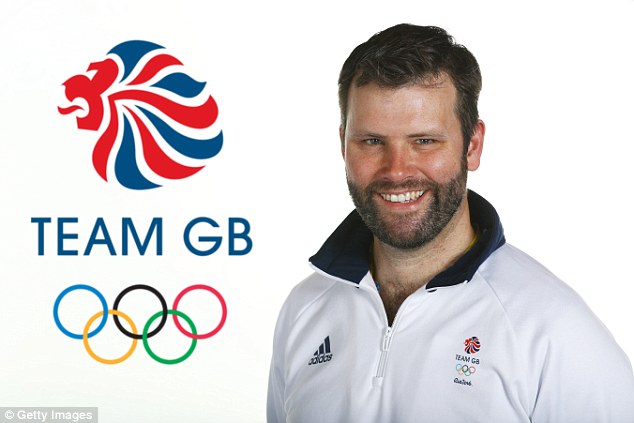
The guy above goes by the name of Phil Burt.
Phil worked for 12 years with the Team GB Cycling Team and Team Sky. He is a physiotherapist by trade, but is acknowledged to be the worldwide expert in cycle-fit – basically the art of adjusting the bike so that the rider is as comfortable and fast as possible.
Phil was one of the famous “marginal” gains made by Dave Brailsford (who revolutionised British Olympic Cycling to where it is today and has won the Tour de France 7 times in the past 8 years!) .
I had the absolute pleasure to go see Phil earlier in the year for a 2 hour bike fit session. The end result was a new saddle, and minor adjustments made to the saddle height and position. He also recommended shorter cranks (the arms that join the pedals to the front drivetrain) – after making the changes I was about 10% faster cycling than before and very much more comfortable…. I salute you Phil!
So that’s my bike!
So, that’s my bike! You may think I’m a speed demon as I’ve mentioned the benefits of going faster many times above – and yes, sometimes speed is important. For riding 1,000 miles, speed isn’t important but being able to cycle at a set speed exerting less energy will make the ride a lot easier.
 Cycling Across Britain